


AI Usage in Indonesia: What the Data Reveals About Adoption, Usage Patterns, and Integration Readiness
06 Jan, 2026
- 18,424 views




2016 - 2026 Copyright @ Graphie.
All Rights Reserved

A few years ago, customer service chatbots were often associated with rigid responses such as, “Sorry, I don't understand your question.” Today, AI technology has evolved dramatically. Chatbots can understand natural language, interpret conversation context, provide recommendations, assist with product searches, handle complaints, and even transfer complex cases to human agents.
But this raises a more important question for businesses: Are Indonesian consumers genuinely satisfied with AI-powered customer service, or do they still prefer talking to a human?
The answer is not as simple as saying “AI is better” or “humans are better.”
Recent surveys and studies in Indonesia reveal an interesting paradox: consumers appreciate the speed and convenience of AI, but they still want empathy, transparency, control, and access to a human when their problems become more complicated.
Indonesia is a highly receptive market when it comes to digital technology. This is also becoming increasingly visible in customer experience.
According to Twilio's State of Customer Engagement Report (SOCER) 2025, which surveyed more than 7,600 consumers and more than 600 business leaders across 18 countries, including Indonesia, AI adoption among Indonesian businesses is already significant.
In fact, 90% of brands in Indonesia reported that AI helps drive business growth, while 90% of businesses also reported increased customer spending through AI-powered strategies.
From a business perspective, AI is clearly no longer just an experiment.
But from the customer's perspective, the story is more complicated.
One particularly interesting finding comes from a survey conducted by Diginex in collaboration with Inventure and Ivosights.
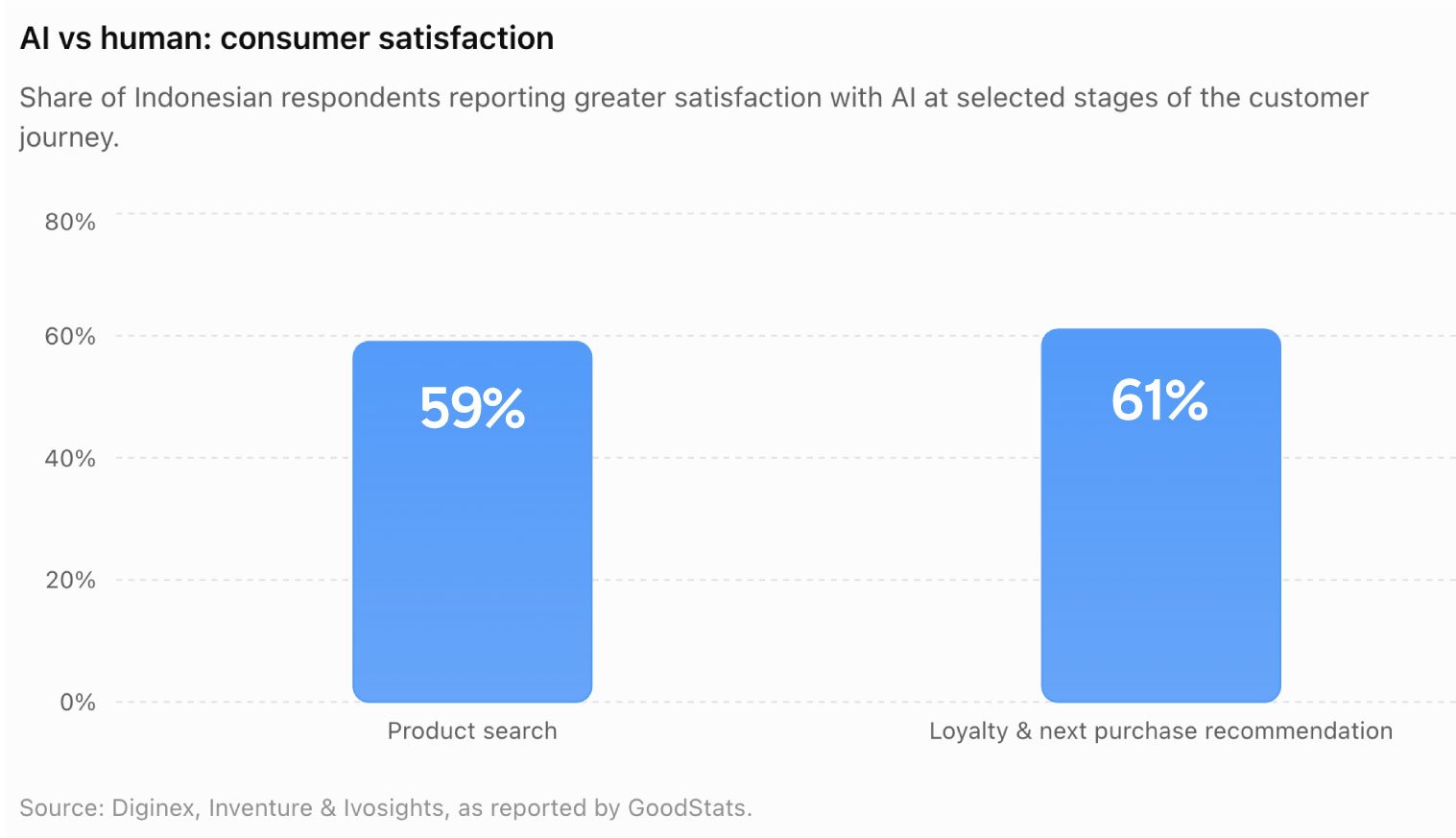
Across different stages of the customer journey, 59% of respondents said they were more satisfied with AI when searching for products. At the loyalty and next-purchase recommendation stage, satisfaction with AI reached 61%.
These numbers are important because they show that AI is not automatically perceived as a poor customer experience.
For activities that require speed, information, search, and instant responses, AI can actually deliver a very positive experience.
Imagine a customer simply wants to know:
“Is this product available?”
Or:
Konsultasi GRATIS tanpa Komitmen, dan temukan strategi terbaik untuk bisnis Anda.
CHAT SEKARANG“How can I return this product?”
Or:
“Where is my order?”
For questions like these, customers may not need a human. They need a fast and accurate answer.
This is where the paradox becomes interesting.
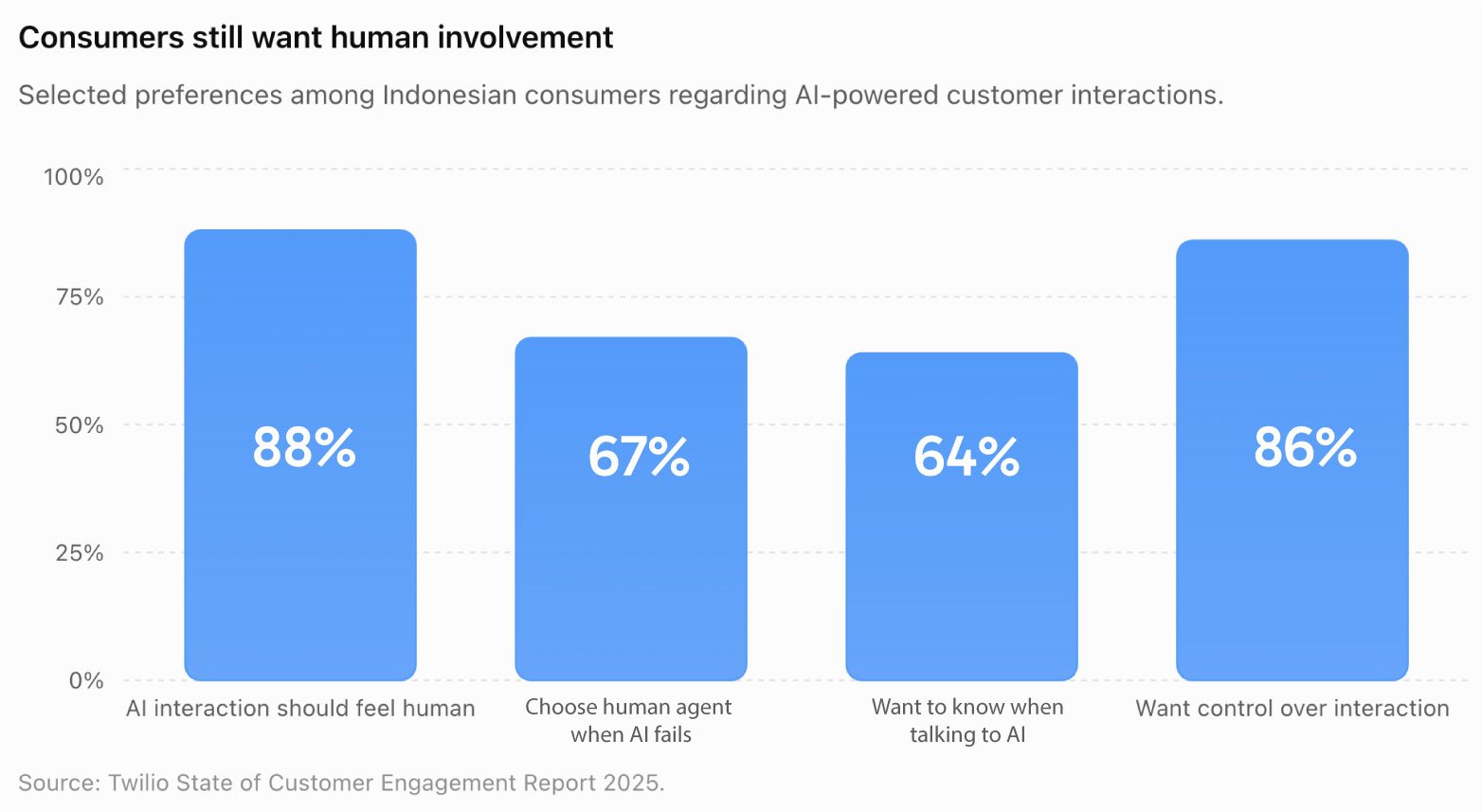
Twilio's survey found that 88% of Indonesian consumers want AI-powered interactions to still feel like interactions with a human. More importantly, 67% would still choose to speak with a human agent when AI fails to resolve their problem effectively.
In other words, Indonesian consumers are not necessarily asking AI to become human.
They want AI to communicate naturally like a human, while still providing an easy path to a human agent when technology cannot solve the problem.
That distinction is extremely important.
Response speed certainly matters. But speed alone does not determine customer satisfaction.
A study involving 235 Tokopedia chatbot users found that chatbot service quality had a positive and significant effect on customer satisfaction and e-customer trust. Customer satisfaction then played an important role in connecting chatbot quality with customer loyalty.
Another study involving 204 Tokopedia users in Jabodetabek found that chatbots and AI recommendation systems could improve customer satisfaction, which subsequently increased customer engagement.
The question, therefore, is not simply:
“Does the company use a chatbot?”
A better question is:
“How effectively does the chatbot solve the customer's needs?”
Research involving chatbot users in Indonesia provides several clues.
A banking chatbot study involving 347 respondents found that chatbot quality influenced perceived usefulness and confirmation, which subsequently strengthened customer satisfaction and the intention to continue using the chatbot. Satisfaction was one of the strongest predictors of continued usage intention.
Meanwhile, research involving Tokopedia chatbot users highlighted factors such as response speed, information accuracy, and problem-solving capability as important components of chatbot service quality.
Across these studies, several factors appear particularly important:
1. Fast responses
Customers do not want to wait several minutes simply to obtain basic information.
2. Relevant answers
A chatbot needs to understand the question, rather than merely match keywords.
3. Accurate information
A fast but incorrect answer is still a poor customer experience.
4. Context awareness
Customers should not have to repeat their entire story every time the chatbot responds.
5. Problem-solving capability
A chatbot that only provides information but cannot actually solve a problem will quickly lose its value.
6. Natural communication
Overly robotic language can make the interaction uncomfortable and frustrating.
This is another interesting development. According to SOCER 2025, 39% of Indonesian consumers said they were beginning to feel tired of AI, while 55% were uncertain whether brands were actually using their customer data for the customers' benefit. This suggests that the more AI becomes part of customer experience, the higher consumer expectations become.
In the past, simply having a chatbot could make a company look innovative. Today, customers are asking: “Does this chatbot actually help me?” If the answer is no, the chatbot itself can become a source of frustration.
Transparency has become an important part of AI-powered customer experience. As many as 64% of Indonesian consumers want brands to disclose when they are communicating with AI rather than a human. In addition, 86% want to have a choice over how they communicate with a brand, even when AI systems can predict their preferred interaction method. This provides an important lesson for businesses.
Do not make your chatbot pretend to be human. Instead, be transparent:
“Hi, I'm an AI Assistant. I can help you find information or resolve your issue.”
Then give customers a choice:
[Continue with AI] [Talk to Customer Service]
This kind of transparency can actually increase a customer's sense of control.
AI has one major advantage that is difficult for humans to deliver at scale: personalization. An AI system can potentially use transaction history, preferences, browsing behavior, location, previously viewed products, and previous interactions to provide more relevant responses. And Indonesian consumers appear to value this capability.
As many as 93% of Indonesian consumers said they are more likely to purchase when brands offer real-time personalized interactions. The problem is that only 44% of brands said they are capable of delivering such experiences. That creates a significant gap.
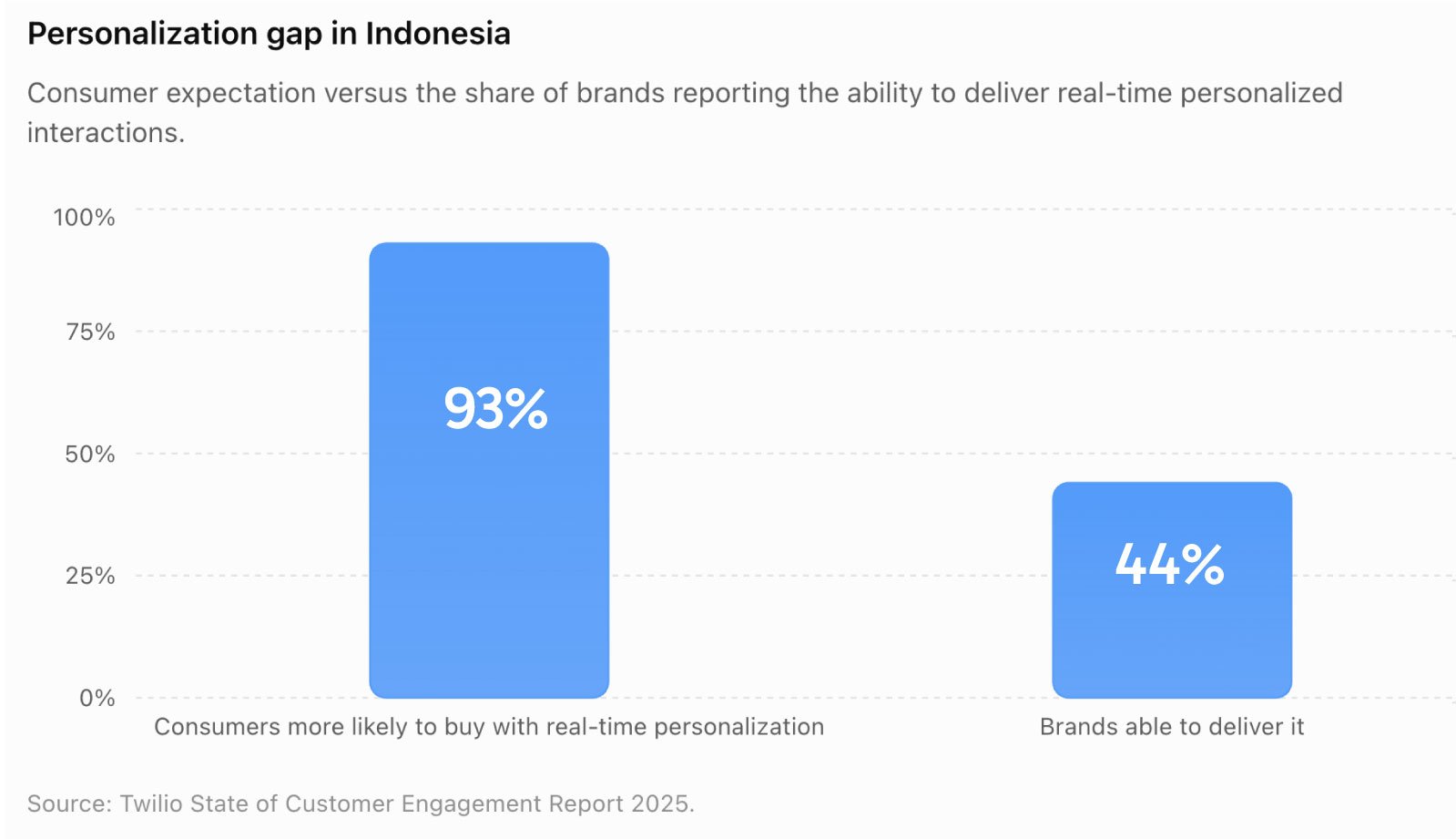
Technology may already exist, but the implementation of AI-powered customer experience is not always mature enough.
Customer service is not simply an operational issue. It is a loyalty issue. Nearly 59% of Indonesian consumers said they would quickly look for an alternative product or service after an unsatisfactory customer experience. More than 40% also said they would purchase a similar product or service from another brand. This makes chatbot failure much more expensive than simply creating an “unhappy customer.”
A chatbot that fails to understand a customer can create a chain reaction:
Bad chatbot experience → frustration → lost trust → search for alternatives → brand switching
The answer is neither.
The strongest model is likely a combination of both.
Chatbots are particularly suitable for:
Humans, meanwhile, remain better suited for:
With this model, the chatbot does not replace customer service.
The chatbot becomes the first line of support, while humans become the problem solvers when needed.
The debate about AI versus humans is increasingly becoming less relevant.
A better question is:
“Which parts of customer service should be handled by AI, and which should remain human?”
AI provides speed.
Humans provide empathy.
AI can operate 24/7.
Humans can understand unexpected situations.
AI can handle thousands of conversations simultaneously.
Humans can make judgments when a situation requires context and discretion.
Therefore, the future of customer service is unlikely to be AI-only. It is more likely to become AI-powered human service.
There are several important lessons.
First, don't implement a chatbot simply because everyone else is using AI.
A chatbot should have a clear purpose: speeding up service, improving availability, reducing repetitive inquiries, or improving customer experience.
Second, don't measure chatbot success simply by the number of conversations handled.
The number of chats answered is not the same as the number of customer problems solved.
More meaningful metrics include:
Third, always provide human escalation.
When a chatbot cannot solve a problem, customers should never become trapped in an endless automated conversation.
A simple “Talk to a Human” option can be one of the most important features in an AI-powered customer service system.
The available data paints a fairly clear picture.
On one hand, Indonesian consumers can be highly satisfied with AI, particularly when it delivers speed, convenience, relevant information, and personalization. The Diginex–Inventure–Ivosights survey found AI satisfaction at 59% for product search and 61% during the loyalty and next-purchase recommendation stage.
On the other hand, consumers do not want to lose control. 88% want AI interactions to feel natural like human interactions, 67% still prefer a human agent when AI fails to solve their problem, 64% want to know when they are talking to AI, and 86% want to choose how they interact with a brand.
So the real question is not whether Indonesian consumers like chatbots.
They like chatbots that work.
Chatbots that are fast, accurate, relevant, transparent, context-aware, and smart enough to know when to hand the conversation over to a human.
Because ultimately, customers do not really care whether the person—or system—answering them is AI or human.
They just want their problem solved.
And perhaps that is the real definition of great customer service in the AI era: technology that works as fast as a machine, while still understanding what people need.






Recommended for you
AI Usage in Indonesia: What the Data Reveals About Adoption, Usage Patterns, and Integration Readiness
The Best Power-Ups and Boosters in Ducky Pop: When and How to Use Them
The Hydrogen Fuel Frontier: Aryanto Misel's Nikuba Tech Shakes the World
The Psychology Behind Match-3 Games: Why Ducky Pop is So Addictive
Feeding the Future: Tackling Global Food Security with AI Agriculture
Ducky Pop: A Splash in the Match-3 Pool
From Idea to Launch: A Step-by-Step Guide to Building Your Dream Startup
The Digital Revolution: How Mobile Apps Have Transformed Our Daily Lives
Ducky Pop: A Splash in the Match-3 Pool
Unlock the Hidden Worlds: Exploring the Different Themes and Levels in Ducky Pop
Tonework: The Future of Personalized Beauty is Here
Typography Tips That Wow: How to Use Fonts Like a Pro
The Future of Website Design: AI-Driven Tools Transforming User Experience
The Power of Data Analytics: How to Drive Growth with Informed Decisions
From Zero to Branded Hero: How Print-on-Demand Empowers Small Businesses